
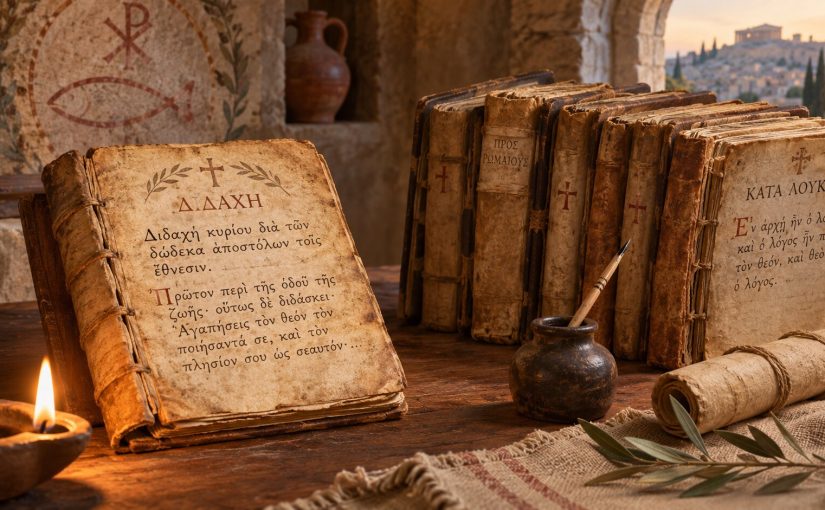
What is the Didache, and why did such an early Christian writing never become part of the New Testament?
The Didache is one of the oldest surviving Christian writings outside the Bible. Its name simply means “teaching.”
Its longer traditional title describes it as the teaching of the Lord through the Twelve Apostles. Yet the document does not identify its actual writer, and scholars do not believe the twelve apostles jointly wrote it.
What makes the Didache important is its practical character. It tells Christians how to live, prepare for baptism, fast, pray, share communal meals, receive traveling teachers, choose local leaders, and prepare for the expected return of Christ.
It therefore gives us something the New Testament rarely provides: a glimpse of how at least one early Christian community tried to organize ordinary religious life.
Yet the Didache was not included among the twenty-seven books that became the New Testament. Why?
The answer takes us into the complicated history of early Christianity and the formation of the Bible.
In this guide:
-
- What the Didache is
- When it was probably written
- Whether the Twelve Apostles wrote it
- What the “Two Ways” teaching means
- How early Christians practiced baptism
- What the Didache says about fasting and prayer
- How it describes the Eucharist
- What it reveals about early church leadership
- Whether early Christians considered it scripture
- Why it was not included in the New Testament
- How the Didache was rediscovered
- Why the book still matters today
Related GodBlog discussions are linked throughout this guide.
What Is the Didache?
The Didache is a short early Christian text containing sixteen chapters. Those chapters are much shorter than chapters in many modern books.
The work is not a Gospel because it does not tell the story of Jesus’ birth, ministry, crucifixion, or resurrection. It is also not a theological letter like Romans or an apocalypse like Revelation.
Instead, it reads partly like a moral guide and partly like a church handbook. Its subjects include moral behavior, baptism, fasting, prayer, the Lord’s Prayer, communal meals, traveling apostles, prophets, teachers, local church leaders, Sunday gatherings, and preparation for the end times.
This unusual combination makes the Didache valuable. It tells us less about what early Christians believed in theory and more about what some of them were actually expected to do.
That difference gives the document much of its historical importance.
What Does the Word “Didache” Mean?
Didache is a Greek word meaning teaching or instruction. The surviving manuscript gives the work a short title referring to the teaching of the Twelve Apostles.
It also preserves a longer title describing the work as the teaching of the Lord through the Twelve Apostles to the nations. That sounds impressive, but it can also be misleading.
The title does not prove that Peter, John, James, and the other apostles personally composed the document. Ancient religious writings were sometimes connected with authoritative figures or traditions even when the actual writer was unknown.
The Didache itself never introduces a named author. It does not say, “I, Peter, wrote this,” and it does not provide twelve signatures.
The title is better understood as a claim that the work represents apostolic Christian instruction. That is different from proving apostolic authorship.
Did the Twelve Apostles Really Write the Didache?
Probably not. Modern scholarship generally treats the Didache as anonymous, and we do not know the writer’s name.
We may not even be dealing with one writer in the modern sense. Different sections may have developed from older materials that were collected and edited together.
The opening moral instruction, for example, appears to draw upon a tradition usually called the Two Ways. Other sections look like practical rules developed for Christian communities.
The final document may therefore represent layers of teaching rather than one author sitting down and composing sixteen chapters at once. This makes the Didache similar to many ancient religious works that preserve older traditions even when the final editor is unknown.
GodBlog’s Reader Guide on Who Wrote the Book of Hebrews? raises a related problem. Hebrews became scripture even though its author remains unknown.
The Didache presents the opposite case. Its author is also unknown, but the work remained outside the New Testament.
Related GodBlog reading:
→ Who Wrote the Book of Hebrews, and Why Is It Anonymous?
When Was the Didache Written?
There is no date written inside the document. Scholars therefore work from its language, church practices, relationships with other writings, and the kind of Christian community the text seems to describe.
Dating remains debated, but many scholars place the Didache somewhere between the later first century and the early second century. Some parts may preserve traditions older than the final document.
That possibility matters because a book completed in the early second century can still contain material that circulated decades earlier.
The safest conclusion is not to attach one exact year. It is better to say that the Didache belongs to the world of very early Christianity, probably close to the period in which several New Testament writings were also being written, circulated, edited, and collected.
Was the Didache Written Before Some New Testament Books?
Possibly. This is one reason the Didache attracts so much attention.
If parts of the work come from the late first century, they may be as early as some writings that eventually entered the New Testament.
The Gospel of John, for example, is usually dated later than Mark. Some New Testament letters also reflect different stages of early Christian development.
The dividing line between the “biblical period” and the “post-biblical period” is therefore not as neat as a modern printed Bible may make it appear.
Early Christian writings did not suddenly stop when the final New Testament book was completed. Communities continued producing sermons, letters, instructions, apocalypses, church rules, and theological arguments.
Only later did Christians develop firmer boundaries around which writings would receive scriptural status.
GodBlog explores this larger historical process in A History of the Bible.
Related GodBlog reading:
→ A History of the Bible
What Are the “Two Ways” in the Didache?
The Didache begins with a striking statement. There are two ways: the way of life and the way of death.
The first several chapters describe what those paths look like. The Way of Life includes familiar moral commands about loving God and neighbors while avoiding murder, adultery, theft, greed, false speech, and other destructive behavior.
The Way of Death presents the opposite picture. It describes a life shaped by violence, dishonesty, selfishness, exploitation, and rejection of what is good.
The structure is simple. Human life contains choices, and some choices lead toward life while others lead toward destruction.
This kind of teaching did not begin with Christianity. Similar “two ways” patterns existed within Jewish moral traditions.
That is important because the Didache does not reveal a Christianity completely separated from its Jewish background. Its moral world grows from older Jewish religious teaching.
Why Is the Jewish Background of the Didache Important?
Christianity did not begin as a religion without a past. Jesus was Jewish, his first followers were Jewish, and Christian scripture inherited Israel’s scriptures.
Christian ideas about God, creation, morality, prayer, covenant, and Messiah all developed within that older religious world.
The Didache shows this relationship clearly. Its moral instructions often sound familiar to readers of the Hebrew Bible and the teachings attributed to Jesus.
Yet the document also shows signs of Christians beginning to define themselves as a distinct community. That tension is historically important.
Christianity was still carrying Jewish traditions while also developing separate practices.
GodBlog discusses the deep dependence of Christianity upon Jewish scripture in How New Is the New Testament?.
The Didache gives us another example. Christianity may be becoming something new, but it is doing so with religious language and moral traditions inherited from Judaism.
Related GodBlog reading:
→ How New Is the New Testament?
Does the Didache Quote Jesus?
It contains teachings that closely resemble material found in the Gospels. These include instructions connected with love of neighbor, treatment of enemies, giving, prayer, fasting, the Lord’s Prayer, and moral behavior.
But the relationship between the Didache and the written Gospels is complicated.
Did the writer know Matthew directly? Did both works draw upon common traditions? Were certain teachings circulating orally?
Different scholars answer these questions differently.
This uncertainty reminds us that early Christianity was not built only through finished books. Teachings circulated orally, communities remembered sayings, teachers repeated traditions, and writings borrowed or adapted older material.
GodBlog’s But Jesus Never Said That explores the broader difficulty of moving from later Christian texts back to the exact words of Jesus.
The Didache belongs within that same world of transmission.
Related GodBlog reading:
→ But Jesus Never Said That
What Does the Didache Say About Baptism?
This is one of its most fascinating sections. The Didache gives practical instructions for performing baptism.
It prefers what it calls living water, generally understood as flowing water. If flowing water is unavailable, other water can be used.
Cold water is preferred in one set of circumstances, but warm water is acceptable. Then comes an especially interesting instruction.
If immersion is not practical, water can be poured over the person’s head three times. The baptism is connected with the Father, Son, and Holy Spirit.
This passage tells us something important about early Christianity. There was an ideal practice, but there was also flexibility.
The community did not seem to believe that baptism became meaningless simply because perfect conditions were unavailable. The ritual mattered, and so did practical circumstances.
Why Does the Didache’s Baptism Instruction Matter?
Later Christians have sometimes debated the correct method of baptism very strongly.
Should a person be fully immersed? Can water be poured? How much water is required? Does one particular physical method make a baptism valid?
The Didache cannot settle every modern denominational argument because different Christian traditions developed long after it was written.
But it does show that at least one very early Christian community allowed practical alternatives.
Running water was preferred. Other water could be used. Pouring was possible when needed.
That picture is less rigid than some modern debates might suggest.
The document therefore gives historians evidence about how Christian rituals operated before centuries of later theology and church law developed around them.
Did People Fast Before Baptism?
According to the Didache, yes. It instructs the person being baptized to fast beforehand.
The person performing the baptism should also fast if possible, and others may join them.
Again, this tells us that baptism was not treated as an isolated physical action. Preparation mattered.
The person entering the community was expected to approach baptism with discipline.
This combination of moral instruction, fasting, and ritual suggests that becoming Christian involved more than agreeing with a list of beliefs. It involved learning a way of life.
The Didache begins with behavior before it gives detailed instructions about worship. That order may itself be meaningful.
Christian identity was expected to become visible through practice.
What Does the Didache Say About Fasting?
The Didache tells Christians to fast on Wednesdays and Fridays. It contrasts these days with other fasting practices associated with Mondays and Thursdays.
The wording can sound harsh because it distinguishes the community from people it labels negatively.
Historically, however, the passage is important because it shows Christian identity beginning to separate itself from surrounding Jewish religious practice.
The striking point is that Christians did not abandon fasting. They changed the schedule.
That means difference developed through continuity. The practice remained while the timing changed.
This is another example of early Christianity maintaining Jewish religious forms while creating new community boundaries.
Modern readers should be careful not to turn this ancient competition over religious identity into contempt for Judaism. The Didache itself comes from a world deeply shaped by Jewish practice.
How Often Does the Didache Tell Christians to Pray?
The Didache gives the Lord’s Prayer and tells Christians to pray it three times each day.
That is remarkable because many modern Christians know the Lord’s Prayer mainly as something used during church services.
In the Didache, it becomes part of daily routine.
The instruction gives us a glimpse of Christianity becoming organized through repeated habits. Faith is not presented only as belief.
People pray, fast, prepare for baptism, gather, share meals, support teachers, and deal with conflict.
The Didache is therefore useful because it brings early Christianity down from abstract doctrine into everyday life.
What Does the Didache Say About the Eucharist?
The Didache includes prayers connected with the communal meal often discussed in relation to the Eucharist.
These prayers do not sound exactly like later Catholic, Orthodox, or Protestant liturgies. That should not surprise us because Christian worship was still developing.
The language emphasizes thanksgiving, gathering, life, knowledge, and community.
One interesting feature is the order in which the cup and bread are discussed. The prayers also do not simply reproduce Paul’s account of Jesus’ final meal.
This tells us that early Christian meal traditions may have been more diverse than later standardized liturgies suggest.
The Didache does place a boundary around participation by connecting the meal with baptism. That indicates ritual belonging was already important.
The meal was communal, but it was not treated as an entirely open social dinner.
Is the Didache’s Eucharist the Same as Communion Today?
Not exactly.
Modern Christian traditions have developed detailed theological explanations of communion. Catholicism, Orthodoxy, Anglicanism, Lutheranism, Reformed Christianity, Baptist traditions, and other churches can disagree strongly about what happens during the Eucharist or Lord’s Supper.
The Didache comes before most of those debates.
Its interest is practical and communal. It provides prayers, describes thanksgiving, and connects the meal with the gathered community.
It does not explain later theological questions using later theological language.
That makes the document valuable precisely because it is early.
It allows us to see Christian worship before centuries of doctrinal development created more formal systems.
What Does the Didache Say About Traveling Apostles and Prophets?
This is one of its most revealing sections.
The Didache describes traveling Christian teachers, apostles, and prophets visiting local communities. They could receive hospitality, teach, and hold respected positions.
But the community was also warned to be careful.
A traveling teacher who stayed too long could become suspicious. Someone who repeatedly demanded money could also raise concern.
The basic problem sounds surprisingly modern.
How do believers distinguish sincere religious teachers from people using religion for personal benefit?
The Didache’s answer is practical: do not accept every religious claim without judgment. Watch behavior, pay attention to money, and observe whether the teacher actually lives according to the teaching.
Religious authority must be tested by conduct.
Were There Still “Apostles” After the Twelve?
The terminology in the Didache is interesting because it speaks of traveling apostles without clearly limiting the word to the original twelve disciples.
That suggests the term could sometimes be used more broadly for missionaries or traveling representatives.
This should not automatically be confused with later theological claims about apostolic authority. Words can change meaning across communities and periods.
The Didache seems to describe a flexible stage of Christian organization.
Traveling charismatic figures still matter, while stable local leaders are also becoming more important.
We may therefore be seeing Christianity in transition from traveling missionaries and prophets toward more permanent local church structures.
What Does the Didache Say About Bishops and Deacons?
The document tells communities to appoint bishops and deacons.
But we should not automatically imagine modern bishops overseeing large dioceses.
Church offices developed over time, and titles that later carried highly specific meanings could be more flexible earlier.
In the Didache, local leaders appear alongside traveling prophets and teachers.
That mixture is historically valuable because it suggests a Christian community where different forms of leadership still coexist.
There are charismatic travelers, prophets, teachers, and locally appointed leaders.
Christian church structure had not necessarily reached the form familiar from later centuries.
The Didache lets us watch that organization developing.
Does the Didache Describe Sunday Worship?
It refers to believers gathering on the Lord’s Day.
They come together, break bread, and give thanks.
The document also emphasizes reconciliation. People in conflict should address their disputes.
This gives worship a moral dimension.
The community cannot simply perform religious acts while ignoring broken relationships.
That connection fits the Didache’s larger message. Religious life is judged by practice.
Prayer matters, ritual matters, and behavior matters too.
The document does not separate belief, worship, and ethics as neatly as later religious debates sometimes do.
What Kind of Christianity Does the Didache Reveal?
A very practical one.
It is deeply concerned with how people behave. It wants believers to avoid violence, greed, dishonesty, exploitation, and sexual misconduct.
It teaches prayer and fasting, regulates baptism, discusses shared meals, warns against fraudulent religious teachers, addresses leadership, and expects Christians to meet regularly.
It also anticipates the end of the present age.
This is not Christianity organized around a complex creed. There is theology in the document, certainly, but the emphasis falls heavily on living.
That makes the Didache particularly interesting when compared with later Christianity, where doctrinal formulas could become major tests of religious identity.
Does the Didache Explain the Trinity?
Not in the form later Christian doctrine would use.
It contains language involving the Father, Son, and Holy Spirit in its baptismal instruction. That is important.
But a triadic formula is not the same thing as the later doctrine of the Trinity.
The detailed theological language used by later councils developed over centuries.
Early Christians could speak about God, Jesus, and the Spirit before agreeing on precisely how those relationships should be defined.
GodBlog’s A History of the Bible discusses the gap between biblical writings and doctrines that took more developed forms later.
The Didache gives us another example of Christianity before later theology became fully systematized.
Does the Didache Look Like the Christianity of Paul?
Sometimes yes, and sometimes not.
Paul’s surviving letters spend substantial time dealing with theology, community disputes, faith, law, resurrection, Christ, and missionary questions.
The Didache is more like a manual. It rarely pauses to build a sustained theological argument.
Its practical emphasis can feel closer to parts of Matthew or James than to Romans.
But that does not mean the Didache represents an entirely separate religion.
Early Christianity was diverse, and different communities faced different problems.
A missionary letter written during conflict naturally sounds different from a handbook teaching converts how to fast and baptize.
The difference reminds us that there was never only one kind of early Christian document.
Was the Didache Considered Scripture?
The answer is complicated.
Some early Christians clearly valued the work. It was known to Christian writers, its teachings influenced later church documents, and some authors appear to have treated it with considerable authority.
But respect and scripture were not always identical categories.
This distinction is essential.
An early Christian community could find a book useful without placing it on exactly the same level as a Gospel or apostolic letter.
By the fourth century, important Christian writers were making clearer distinctions between books considered canonical and books considered valuable for instruction.
The Didache ended up in the second category rather than the first.
What Did Eusebius Say About the Didache?
Eusebius of Caesarea wrote about Christian books in the early fourth century.
He tried to describe which writings were widely accepted, disputed, or rejected.
The Didache appears outside the accepted New Testament collection in his discussion.
That tells us something important.
The document was known and had not simply disappeared. But awareness did not automatically produce canonical status.
Christians could recognize the Didache as an ancient religious work while still distinguishing it from the books they increasingly regarded as New Testament scripture.
Canon formation was therefore not simply a matter of age.
An old Christian document was not automatically biblical.
What Did Athanasius Say About the Didache?
Athanasius provides an especially useful example.
In 367 CE, he listed the books he regarded as belonging to scripture. His New Testament list corresponds to the twenty-seven books familiar to Christians today.
But he also mentioned other writings that could be read for instruction.
The Teaching of the Apostles, generally understood as the Didache, appears among those useful works.
This creates an important distinction.
The Didache was not condemned as worthless. It was not treated simply as dangerous heresy.
It could be read and used to instruct Christians.
But Athanasius did not place it inside his canonical list.
That helps explain how early Christianity could respect a text without eventually putting it in the Bible.
Why Wasn’t the Didache Included in the New Testament?
There is probably no single answer.
The New Testament canon developed gradually. Different Christian communities used different writings.
Over time, several factors influenced which books achieved broad scriptural authority. These included connections with apostles, widespread use, theological acceptance, and long-term recognition across Christian communities.
The Didache faced several difficulties.
Its actual author was unknown. Its claim to represent apostolic teaching did not prove direct apostolic authorship.
Its use may not have been equally widespread everywhere, and other writings became more central within Christian worship and theology.
By the time clearer canonical lists appeared, the Didache occupied a respected but secondary position.
This is very different from saying that one council gathered, examined the Didache, and voted to remove it from the Bible.
The historical process was slower and less tidy.
Was the Didache Removed From the Bible?
No evidence shows that the Didache once belonged to a universally accepted New Testament and was later secretly removed.
This is an important distinction.
Modern discussions of “lost books of the Bible” can create a misleading picture.
They may suggest that early Christians once had a much larger Bible until church leaders deliberately deleted inconvenient texts.
The actual history is more complicated.
There was a period when the borders of Christian scripture were still developing.
Some books were accepted widely. Others were disputed. Some were useful but noncanonical. Some were rejected.
The Didache belongs to this history of selection and reception, not a simple story of removal.
It was an important Christian book that did not achieve the same canonical status as Matthew, Romans, or other New Testament writings.
Did Church Leaders Reject the Didache Because It Contained Dangerous Ideas?
There is no good reason to reduce the story to that explanation.
Much of the Didache is hardly revolutionary from a Christian perspective.
It teaches moral behavior, contains baptismal instructions, encourages prayer, discusses communal worship, and warns against false teachers.
Early church authorities who left it outside the canon could still recommend it for instruction.
That would be strange behavior if they were desperately trying to suppress its contents.
The more ordinary explanation is also the stronger one.
The Didache was valued, but other writings gained broader and more lasting recognition as scripture.
Not every useful early Christian book became biblical.
Why Did Hebrews Enter the Bible but the Didache Did Not?
This comparison is especially interesting because both books are anonymous.
GodBlog’s Who Wrote the Book of Hebrews? explains that Hebrews was sometimes connected with Paul, although that authorship remains doubtful.
That traditional Pauline association may have helped Hebrews in some regions. But authorship alone does not explain everything.
Hebrews also became deeply embedded in Christian theological reading.
The Didache followed another path.
It remained useful as instruction and church order but did not gain the same widespread scriptural recognition.
The comparison shows why there was no single mechanical rule for canon formation.
Anonymous authorship did not automatically exclude a book, and claimed apostolic authority did not automatically include one.
Reception mattered.
Why Did Revelation Enter the Bible While the Didache Did Not?
Revelation provides another useful comparison.
Its canonical history was not simple. Some early Christians questioned it, and different regions evaluated it differently.
Yet Revelation eventually secured a place in the New Testament.
GodBlog discusses its difficult place within Christian scripture in The Book of Revelation Isn’t Nuts, but It Subverts the Spirit of Christianity.
The Didache experienced the opposite outcome.
It was respected by some Christians but remained outside the final New Testament collection.
These different histories remind us that the Bible’s table of contents has a history of its own.
Related GodBlog reading:
→ The Book of Revelation Isn’t Nuts, but It Subverts the Spirit of Christianity
Was the Didache Lost?
For many centuries, the complete text was unavailable to scholars.
Ancient writers mentioned a work called the Teaching of the Apostles, so people knew something by that name had existed.
But the text itself was largely inaccessible.
That changed in the nineteenth century.
In 1873, Philotheos Bryennios discovered the work inside an old manuscript collection in Constantinople.
The manuscript itself had been copied centuries earlier, in 1056. Bryennios later published the Didache in 1883.
The discovery caused enormous scholarly interest.
A Christian work discussed in antiquity had returned to view.
The Didache was therefore not a newly invented text. Its existence had been known from ancient references.
What scholars gained was the surviving text itself.
Why Is the Rediscovery So Important?
Imagine discovering an instruction manual from Christianity’s earliest generations. That is roughly what scholars received.
The Didache does not suddenly rewrite everything we know about Jesus.
It does something different.
It fills in gaps.
The New Testament tells us about Christian beliefs, missionary activity, conflicts, letters, and stories about Jesus.
The Didache shows us how a community might answer more ordinary questions.
What water should we use for baptism? When should we fast? How often should we pray? How should we treat visiting teachers?
What if a religious traveler asks for money? Who should lead the local community? How should Christians prepare for worship?
These questions make early Christianity feel less distant.
They show believers trying to turn a growing movement into everyday community life.
What Does the Didache Tell Us About False Teachers?
It tells us early Christianity already had a problem with them.
Religious authority attracted people with different motives. Some traveling teachers were sincere, while others may have taken advantage of hospitality.
The Didache therefore gives practical tests.
A visitor cannot simply announce spiritual authority and expect unlimited support. Behavior matters, money matters, length of stay matters, and consistency matters.
This is striking because it shows that disputes about religious leadership did not begin with modern televangelists or large churches.
Christian communities faced questions about trust, authority, and money almost from the beginning.
The Didache’s response is remarkably practical: look at how the teacher lives.
What Does the Didache Say About the End of the World?
The final chapter turns toward the future.
It warns believers to remain watchful and describes deception, testing, and events connected with the expected end.
Early Christianity lived with a strong expectation that history was moving toward a divine conclusion.
That expectation also appears in Paul and Revelation.
The Didache therefore combines ordinary church life with apocalyptic hope.
Christians must know how to baptize people, appoint leaders, deal with visitors, and organize worship.
But they must also remain ready for God’s final intervention.
That combination may seem strange today.
For early Christians, the practical and apocalyptic belonged together.
Did the Didache Expect Jesus to Return Soon?
Its final section certainly reflects an urgent expectation of future events.
This was not unusual within early Christianity.
Paul’s letters contain strong expectations about Christ’s return. The Gospels preserve sayings about watchfulness, and Revelation is built around divine judgment and renewal.
The Didache belongs inside that same atmosphere.
Early Christians did not always imagine Christianity continuing for two thousand years.
Many lived with a much more immediate expectation.
History continued. Church institutions became more permanent, and the expectation had to be interpreted again and again.
The Didache lets us encounter a stage when that future still felt close.
How Is the Didache Different From a Gospel?
A Gospel tells a story about Jesus. It asks who Jesus was, what he taught, why he was crucified, and what happened afterward.
The Didache assumes a Christian community already exists. It does not spend much time explaining who Jesus was because its focus is practical.
It asks how Christians should live, baptize, fast, pray, receive teachers, and organize community life.
That difference is crucial.
A Gospel remembers and interprets the story of Jesus.
The Didache helps organize the movement growing in his name.
Does the Didache Change What We Know About Early Christianity?
It adds complexity.
Modern Christianity can sometimes make the early church appear unified from the beginning. There was Jesus, then the apostles, then the Bible, and finally the church.
History was not that simple.
Early Christians lived in different communities and preserved different traditions. They argued, developed rituals, created leadership structures, and interpreted Jewish scripture in different ways.
They also expected Christ’s return and produced many writings.
Some of those writings entered the New Testament. Others did not.
The Didache allows us to see part of that process happening before later Christianity became more standardized.
Does the Didache Challenge the Bible?
It does not need to.
Its value does not depend upon replacing the New Testament.
The Didache is useful because it gives us another early Christian voice.
Reading it can help us understand the environment in which Christianity developed.
It shows that the canonical books were not the only Christian writings circulating in the ancient world.
That fact need not threaten the Bible. It simply gives the Bible a history.
GodBlog repeatedly approaches scripture in this historical way.
A History of the Bible is especially relevant because it asks readers to understand the Bible as a collection that developed over time rather than as one book produced in a single moment.
Should the Didache Be Added to the Bible Today?
That is a different question from whether the Didache is historically important.
Church traditions have lived with established biblical canons for many centuries.
The discovery of an old Christian text does not automatically require rewriting those canons.
The Didache can be read without being called scripture.
In fact, that resembles how some ancient Christians treated it.
They valued it and used it for instruction without necessarily placing it among canonical books.
Modern readers can do the same.
The Didache can illuminate Christian history without becoming another New Testament book.
Why Does the Didache Matter Today?
The Didache matters because it makes early Christianity more concrete.
The document shows Christians trying to answer ordinary questions about life, prayer, baptism, trusted teachers, leadership, shared meals, conflict, and faithfulness.
Those questions are not distant.
Religious communities still ask versions of them.
The answers may have changed, and church organization has certainly changed.
Christian theology has also developed enormously.
But the underlying challenge remains familiar:
How does a religious movement turn its ideals into a way of life?
The Didache is one early attempt to answer that question.
What Is the Best Answer to “What Is the Didache?”
The simplest answer is:
The Didache is an anonymous early Christian teaching manual that describes moral behavior, worship, baptism, fasting, prayer, church leadership, and community life.
It probably reached its surviving form sometime around the late first or early second century, although parts may preserve older traditions.
The Twelve Apostles probably did not personally write it. The title instead presents the work as carrying apostolic teaching.
Some early Christians respected it greatly, while others placed it outside the books regarded as scripture.
By the fourth century, writers such as Athanasius could recommend the Teaching of the Apostles for instruction while still excluding it from the New Testament canon.
That distinction explains its unusual place in Christian history.
The Didache was neither simply forgotten nor condemned.
It occupied a middle position.
It was useful, ancient, and respected, but it was not ultimately included in the New Testament.
That may be precisely why it remains so interesting.
It allows us to hear a voice from early Christianity that stands close to the biblical world without actually becoming part of the Bible.
Guide Summary
The Didache opens several larger questions already explored throughout GodBlog.
How did the Bible develop into the collection Christians know today?
→ A History of the Bible
How deeply did early Christianity depend upon Jewish scripture and tradition?
→ How New Is the New Testament?
What happens when an important early Christian text has no known author?
→ Who Wrote the Book of Hebrews, and Why Is It Anonymous?
Why should readers be careful when reconstructing the earliest form of Christian texts and teachings?
→ But Jesus Never Said That
Did early Christians immediately agree about which books belonged in scripture?
→ The Book of Revelation Isn’t Nuts, but It Subverts the Spirit of Christianity
Read together, these discussions show why the Didache is more than a religious curiosity.
It opens a window onto Christian life before the boundaries of the New Testament were fully settled. It also reminds us that early Christianity produced more writings than the twenty-seven books that eventually became its New Testament.
About This Reader Guide
This guide connects the Didache with related GodBlog discussions about early Christianity, biblical history, anonymous writings, Jewish tradition, textual development, and the formation of the New Testament.
The Didache was not a secret Gospel removed from the Bible. It was something different: a practical guide for Christians trying to turn religious teaching into everyday community life.
Its instructions about baptism, prayer, fasting, worship, leadership, and traveling teachers show Christianity developing before many later church structures became fixed.
Early Christians could respect such a work without agreeing that it belonged in scripture. That distinction is important.
The Didache helps us see that the New Testament did not appear as a finished collection overnight.
Books circulated, communities read them, teachers debated them, and some eventually became scripture.
Others remained valuable Christian writings outside the canon.
The Didache stands in that second group.
It was not included in the Bible, but it remains one of our most revealing windows into the world in which Christianity was becoming a church.